



The Democracy We Are Making: Philanthropy and America’s Next 250 Years
America’s founding document was written by a few. Its democracy is written by everyone.
Veritas
Sister Christina was a tough-as-nails nun who ran the St. Francis Center of Redwood City. She struck me as soft-spoken yet unyielding. She had a vision to build and launch a youth center that could provide after-school programs in the North Fair Oaks neighborhood.
I was a youth development program officer at the S.H. Cowell Foundation at the time and, years later, would eventually join the center as a board member and individual donor.
In its founding, St. Francis Center’s work focused on human services and basic needs to support many immigrant households. These families worked hard but struggled to scrape by, living in a costly neighborhood in the heart of Silicon Valley.
St. Francis offered a food bank and a clothing pantry. It provided ESL classes and hosted a very popular toy giveaway during Christmas. It also ran a community garden that brought residents together, inspired a connection to the earth, and supplemented groceries. All of this work was powered almost entirely by volunteers, upwards of 200 each year.
Sister Christina had never launched a capital campaign before, nor had she worked with contractors or constructed a building. None of that stopped her from establishing a brand-new youth center from the ground up. She rallied the support of individual donors and foundations, including a grant from the Cowell Foundation. She didn’t incur any cost overruns, and the project was completed on time. The building included one unit of housing where she envisioned the youth center’s director would live — and he did, a young man from the area. After opening, stipends were provided for teens to work as youth leaders.
In her sun-filled office, she kept two huge Labradors who always obeyed and would find a place to settle at her feet. As I came to know her well, I would often say that I wanted to be a nun like Sister C, as I affectionally called her. She was a very effective leader. Quiet but uncompromising. Firm in her commitment to recognizing and fostering the dignity of all people, especially the often-marginalized families in the neighborhood.
One year for her birthday, she got a tattoo on the inside of her right wrist that read “Veritas” in cursive. Truth, the thing she always returned to in her view of the work.
Sister C continued to expand. Recognizing lack of affordability and absentee landlords as major challenges, she set her sights on buying a 6-unit apartment building that was fully inhabited but unsafe and run down. Once again, the community, individuals, foundations, and small businesses came together to support the cause. Donors gave in amounts from $5 to $50,000 to $5,000,000.
She renovated each unit, converting moldy, derelict spaces into pristine, dignified, and, above all, safe apartments, restoring the pride that all humans deserve. Rather than displacing occupants, she purchased new appliances and furniture if the tenants needed them, stabilized their rent and, in some cases, reduced it. Like the youth center before it, the renovation project came in at budget and on time. The construction manager, like her Labradors, responded well to her quiet but firm determination.
Sister C and the community of donors repeated this action of raising money and buying dilapidated apartment buildings to serve as affordable housing. She stewarded the organization as it grew from a small social service outfit into a community anchor that owned nearly every apartment in the neighborhood. It currently operates 268 units of extremely low, very low, and low-income housing in the North Fair Oaks Neighborhood and in Downtown Redwood City.
I no longer serve on the board and Sister C has since moved into a leadership role in her order. But her impact endures. Children have access to enrichment opportunities. Families are safe, live with dignity, and give back to one another. This is a strong community, a great place to live.
Sister C never set out to make an argument about democracy. But her life makes one anyway.
Shared Responsibility
As the United States approaches its 250th anniversary, there has been an abundance of reflection on our nation’s founding, its triumphs and failures, and the work that remains ahead. Those conversations matter. Still, there is another American story worth telling.
It is the story that people like Sister C tell with their lives: the story of citizens who come together to build and leverage institutions to make vibrant community life possible.
Long before government programs existed at their current scale, Americans — particularly those pushed to the margins — organized libraries, schools, congregations, neighborhood associations, and mutual aid. They volunteered, raised money, addressed local problems, and invested in causes larger than themselves. They understood that strong communities do not happen by accident. They are built.
One of America’s greatest traditions is not simply self-government. It is shared responsibility — a phrase that, not coincidentally, sits at the center of how we think about our own work at the Fund.
As we celebrate our nation’s 250th birthday, let’s remember that the American experiment has yet to be completed. Every generation becomes an heir to both the achievements and the shortcomings of those who came before. Every generation is called to strengthen what it has inherited.
The Architecture and Its Inhabitants
The Constitution provides the architecture of American democracy. At its best, it establishes our institutions, distributes power, and protects our freedoms. But architecture alone cannot sustain a democracy. Democracy is lived through communities.
It depends upon neighbors who trust one another, nonprofit organizations that bring people together, local leaders who solve problems, artists who help us imagine a shared future, and residents who choose participation over cynicism. Our laws establish rights and responsibilities. Our civic norms determine how faithfully we honor them. Healthy democracies require both.
Every year, around the anniversary of the Walter & Elise Haas Fund’s inception, I return to the oral histories of its founders, Walter Haas and Elise Stern Haas. I read them not simply as history, but as conversations across generations.
Walter and Elise lived through the 1906 San Francisco earthquake, the Great Depression, two world wars, and periods of profound social and economic upheaval. They experienced uncertainty, polarization, and disruption. Yet their response was not to retreat from civic life. It was to invest more deeply in the institutions and relationships that helped communities endure.
They understood something that remains true today: healthy communities depend upon strong institutions, and strong institutions depend upon people willing to sustain and invigorate them.
Philanthropy as a Duty
For Walter and Elise, philanthropy was never simply about giving money away. It was a duty.
They believed that those who benefited from a community also bore some responsibility for strengthening it. Whether supporting universities, hospitals, museums, cultural hubs, civic organizations, or neighborhood initiatives, they viewed philanthropy as one way of contributing to the common good. That view on philanthropy feels especially relevant today.
We should not lose sight of what nonprofits make possible. Every day, nonprofit organizations, like the St. Francis Center and our own grantee partners, feed families, mentor young people, preserve culture, advance scientific discoveries, protect civil liberties, support artists, respond to disasters, strengthen local economies, and create places where people gather, volunteer, organize, worship, learn, and celebrate. They transform strangers into neighbors and neighbors into communities. In doing so, they strengthen democracy itself.
Structure and Culture
Increasingly, I think about democracy in two complementary ways. One depends upon constitutional guardrails: the rule of law, independent courts, free elections, a free press, and the institutions that prevent the abuse of power. The other depends upon civic culture: trust, belonging, participation, and our willingness to work across differences.
We often treat these as separate conversations. They shouldn’t be. Government institutions sustain democracy. Communities live it. When constitutional guardrails weaken, communities suffer. When civic trust and belonging erode, constitutional institutions become harder to sustain. Each depends upon the other.
This understanding has shaped the evolution of the Walter & Elise Haas Fund. Some of our grantmaking strengthens the formal institutions that protect democracy. Other investments support belonging, civic participation, economic opportunity, bridge-building across differences, community leadership, arts and culture, and the neighborhood organizations that make civic life possible.
These may appear to be different kinds of grants. I see them as complementary investments in the same democratic future. One protects democracy’s apparatus. The other strengthens its operating system. Together, they help create communities in which people can participate, contribute, lead, and flourish.
The Work of Renewal as a Country and as a Field
As the country marks its 250th anniversary, I hope we recommit ourselves to the work of renewal. The United States remains an ongoing project. So too is philanthropy. Both evolve, sometimes imperfectly, toward a broader understanding of who belongs, whose voices matter, and what it means to seek the common good. That work continues.
The next chapter of the American story will not be written by government alone. It will be written by millions of people choosing every day to strengthen their communities, support institutions that serve others, and invest in a future they may never personally see.
Perhaps that is philanthropy’s greatest contribution to democracy. Not simply generosity. Not simply addressing today’s problems. But supporting nonprofits and building the civic foundations that future generations will inherit.
Our 250th anniversary is an opportunity to celebrate what previous generations built. It is also an invitation to ask what kind of ancestors we intend to become. I think of Sister C’s wrist, that quiet, permanent note-to-self to see the truth about what people need and then pursue the work of creating it. The answer depends not only on the strength of our institutions, but on the strength of our communities, and our willingness to invest in both.
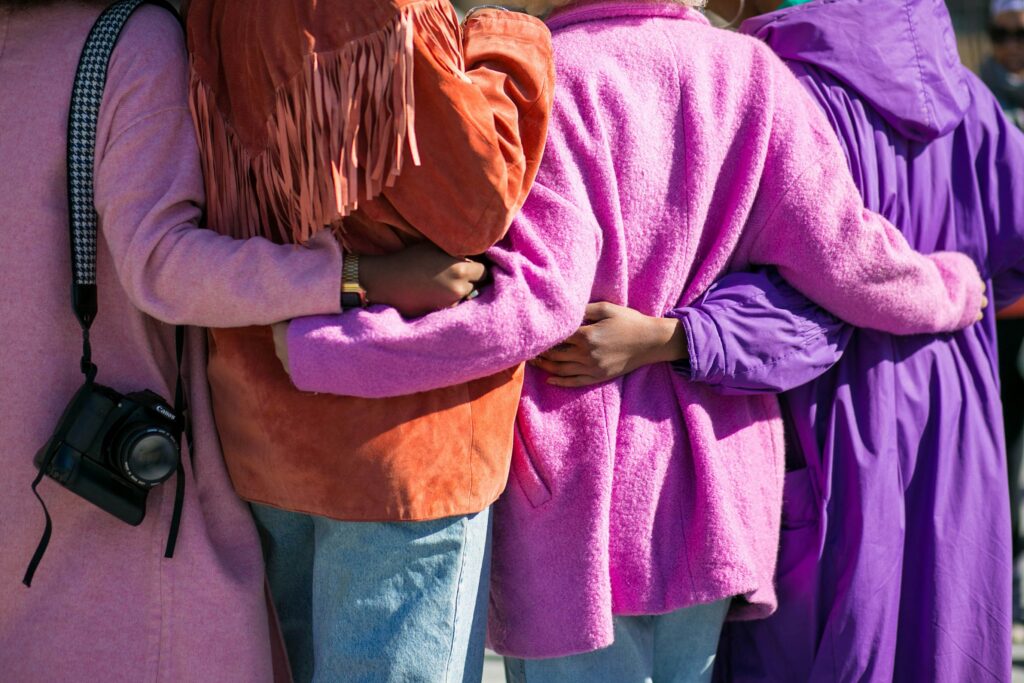
Photo by Vonecia Carswell on Unsplash
Thank you for this beautiful and deeply moving letter. Its humanity awakens something very hopeful in me: a reminder that democracy lives through dignity, care, shared responsibility, and the communities we build together.