



Lessons in Trust: The Nerve to Get It Wrong
What does it take to practice trust-based philanthropy, not as an aspiration, but as an ongoing institutional commitment?
In February, foundation executives gathered to wrestle with that question honestly.
What they found: the learning journey matters more than the destination, and the willingness to get it wrong may be the most important condition of all.
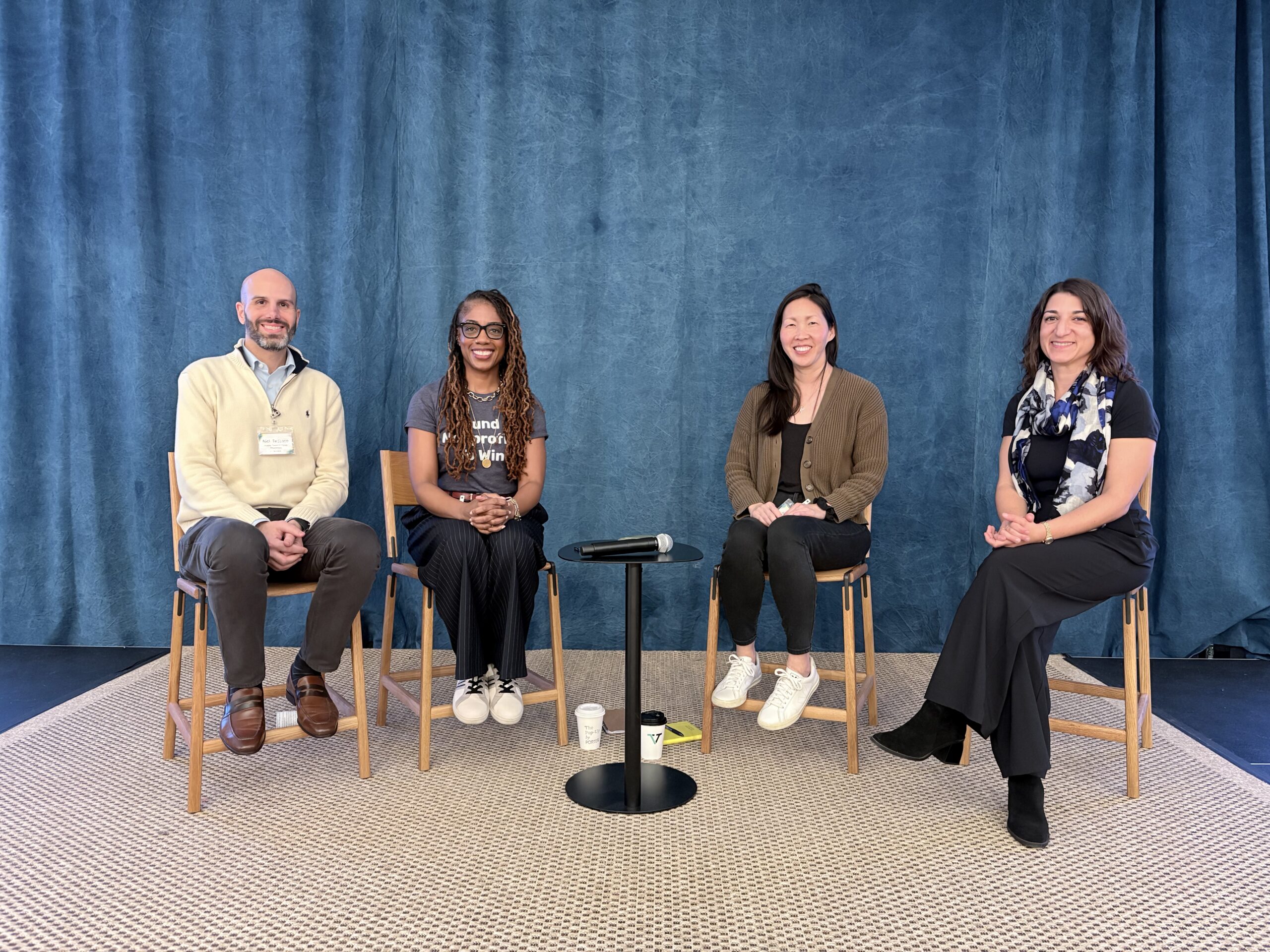
“These are hectic times,” Shaady Salehi said. It was an all too familiar feeling among the attendees in the room. “How do we balance being responsive and being steady?” It was early February, and about 40 foundation executives and trustees had gathered in San Francisco, not to celebrate what philanthropy has accomplished, but to reckon with what it hasn’t. Nobody in the room needed to be told what “hectic” meant. They are living it, and so are the nonprofits they fund.
This is a moment of compounding crises. Nonprofits are facing exploding demand for services, staff burnout, collapsing government funding, and cuts from private philanthropy too. Report after report shows that foundations believe they are responding well to the moment. Nonprofits disagree. And underneath the funding gaps and capacity strains is something harder to quantify — a climate of cruelty, much of it public, much of it coming from the federal government, directed at the very communities these organizations serve.
Nobody in the room needed to be told what “hectic” meant. They are living it, and so are the nonprofits they fund.
Within that context, Fatima Angeles set the tone.
“The Levi’s Foundation has been supporting communities for 53 years,” said the foundation’s Executive Director, welcoming the group to Levi’s Plaza. “An organization with roots that trace back to its founding by immigrants. As I stand before you today, I do so, not only representing this foundation, but also speaking as an immigrant myself.” She offered a powerful invitation: “For those of us in the funding community, this moment demands that we cultivate the ability to be flexible and approach our work differently than we have in the past. This is fundamentally a call to boldness.”
What does boldness look like? That’s what the rest of the day tried to answer and it’s a harder question than it sounds. Trust-based philanthropy, an approach that shifts power toward nonprofits through unrestricted funding, lighter reporting requirements, and deeper relationship, has been gaining traction for years. But not everyone has subscribed.
Boldness isn’t a moment — it’s a practice
Shaady Salehi, co-Executive Director of the Trust-Based Philanthropy Project advanced that thread through much of the conversation: “Boldness requires steadiness; and being bold can take different shapes depending on your context and starting point.” This is not the boldness of a single moment. It’s the slower, harder work of building an institution that nonprofits can rely on.
Nick Tedesco, President and Chief Executive Officer of the National Center for Family Philanthropy pushed the group toward a distinction that often gets lost in conversations about trust-based philanthropy: the difference between adopting its practices and creating the conditions for those practices to endure. “We often talk about the practices,” he said, “but not the conditions. Organizations may take on the practices but not have the conditions for those practices to last.”
This is not the boldness of a single moment. It’s the slower, harder work of building an institution that nonprofits can rely on.
What are those conditions? Nick described them at two levels. The first is personal. “Readiness at the self level — mental models, cognition, recognizing one’s orientation to control or risk, or fear in the movement of resources. If you don’t get to the core of that, you will not have the ability to move forward.” The barriers here are internal: too many choices, worries about reputational risk, or discomfort with ceding control. Until those are named and interrogated, no amount of practice change will hold.
The second level is systemic. Is the organization itself primed? Does it have open lines of communication, space for self-reflection and learning, and governance structures that are nimble enough to respond to its partners’ needs? “Is that governance working for you and your partners?” Nick asked. It’s a question most foundations are encouraged to ask directly and more frequently.
I’d like to see our sector grow more comfortable with experimentation and making mistakes,
Jamie Allison, Executive Director of the Walter & Elise Haas Fund brought a sharper edge to the conversation. She noted that almost every other sector treats improvement as a constant — “it seems like every week my phone updates to a new operating system” — while philanthropy tends to treat its inherited practices as permanent. Her challenge to the room: “I’d like to see our sector grow more comfortable with experimentation and making mistakes,” because those mistakes, for philanthropy, would represent new movement.
The fear of getting it wrong
That word, mistakes, opened something up. Participants leaned into this topic: what about the fear, especially among those newer to trust-based philanthropy, of doing things “the wrong way”? How do you build a culture where imperfection is survivable, even instructive?
Nick reframed the question around voice and courage. “What would it mean for us to be committed to bravery? What do we lose when we don’t share our voice, even as we are trying to find it?” He pointed to something larger than philanthropy. Building the muscles for managing conflict, for being open and honest across difference, isn’t a philanthropic skill set. It’s a human one that the sector has to develop deliberately.
How do you build a culture where imperfection is survivable, even instructive?
Part of that work, Nick suggested, involves trustees rethinking their own role. In a trust-based model, the traditional trustee function — approving grants, representing institutional wealth — shifts. The idea of that shift prompts some trustees to ask themselves, “If I’m not approving grants, representing the wealth, what is my role to play?” That disorientation is real, and it doesn’t resolve itself. It requires active reorientation: learning to delegate, to trust staff and partners, to see one’s role in relation to others rather than above them.
The panelists converged on learning, not as a program or a framework, but as a genuine organizational stance. Angie Chen, Executive Director of the Skyline Foundation put it plainly: “None of us in trust-based philanthropy would win a gold medal in trust-based philanthropy. That doesn’t mean we should stop trying.”
None of us in trust-based philanthropy would win a gold medal in trust-based philanthropy. That doesn’t mean we should stop trying.
Nick added a practice to that stance: the discipline of observing with curiosity rather than judgment. “How do we observe with curiosity and without judgment? With a growth mindset?” he asked. “Making space to ask all the questions. Depersonalizing from identity.” It’s a deceptively simple idea and one that runs counter to how most institutions are structured, which reward certainty and decisiveness over openness and inquiry.
Jamie spoke to what this requires of leaders specifically: “As a leader of a foundation, my work is dynamic, so my leadership has to be dynamic. I have to meet trustees and my staff where they are at.” And then, on the question of navigating disagreement: “We have to be okay with creating a container for disagreement so people can say what they need to say, learn together, and then make decisions together. We try to have long runways before any actual decision-making.” For Jamie, unanimous agreement isn’t the goal and may not even be desirable. “Productive conflict is a good thing. Sometimes we have points of view that are not unanimous.” When people advocate from their own perspectives, when the room isn’t in lockstep, “this means the system is working.”
What it looks like in practice
The most clarifying question of the day may have been the simplest. Jamie Allison described the moment her foundation began asking it: What would it look like to fund our partners like we wanted them to win?
It sounds obvious. But when the Walter & Elise Haas Fund held that question up against its own grantmaking, the answer was uncomfortable. “$15,000 annual grants to 400 nonprofits doesn’t sound like an endorsement,” Jamie said. Neither did the one-year grant cycles, the applications, and the reporting requirements. These were the conversations, she explained, that ultimately led to the launch of the Endeavor Fund, a bold grantmaking strategy that concentrated larger sums on fewer organizations over a seven-year period, funded like the foundation actually wanted them to win.
Productive conflict is a good thing.
But Jamie was careful not to make the story sound easy. Change of that magnitude carries downsides alongside it. The board understood the value of what they were moving toward — the long-haul relationships, the grassroots partners, the deeper commitment. And they also grieved what they were leaving behind: the frequency of giving, the familiar name-brand institutions, the old rhythm of the work. “Even as we welcome change,” Jamie said, “grief and loss accompany those changes.” Naming the grief rather than papering over it is itself a trust-building act.
Angie Chen brought a different kind of complexity to the surface. Skyline has grown significantly over the past five years, from $44.5M in grantmaking in 2021 to $122M in 2025 and from 5 to 13 staff over the same timeframe. With that growth has come the challenge of cultivating trust not just with grantees, but across every layer of the institution: board, staff, and partners alike. Grantees, Angie noted, often have the clearest experience of trust-based philanthropy because they feel it directly. The more complex work is translating that experience back into the organization, helping staff and trustees understand what it looks like to truly shift power and why it matters.
What would it look like to fund our partners like we wanted them to win?
And here Angie offered a new consideration regarding the barrier to adopting trust-based philanthropy. It isn’t always the board or Executive Directors. “My experience in the TBP community is that program staff often view leadership as the barrier to trust-based philanthropy,” she said. “However, staff can also be the barrier. As a longtime program officer, I know that the old way of working — applications, reports, structured touchpoints — makes the job more manageable.” Accountability, in a traditional model, is built into the paperwork. Trust-based philanthropy asks staff to hold accountability differently, relationally, which is harder. “How do we hold ourselves accountable,” Angie asked, “especially in this moment, when grantees are experiencing so much harm?”
Her answer pointed toward program officers themselves. Because they are closest to the work, they are best positioned to understand it and to tell its story to boards and the public. That proximity is an asset that most foundations underuse. “They play a pivotal role,” she said, “in advancing the work and advancing trust-based philanthropy.”
The throughline
Across all of it — the frameworks and the stories, the fears and the experiments — one thing kept surfacing. Trust as a practice. Every panelist described listening before acting, putting themselves in the shoes of their trustees, their staff, their grantee partners.
Nick brought this into sharpest focus through the lens of stewardship, a word the sector uses often and interrogates rarely. “Who is making decisions, how are they made, to whom are we accountable?” he asked. “There are a lot of people who depend on us.” In his framing, stewardship isn’t about protecting institutional wealth or maintaining donor intent in its narrowest sense. It’s about recognizing that philanthropic capital exists for public benefit and making decisions accordingly. “It is up to us to choose in such a way that trust-based philanthropy is not optional.”
[Program Officers] play a pivotal role in advancing the work and advancing trust-based philanthropy.
He also named something the room had been circling: a conversation about power and privilege in philanthropy. The way through it, he suggested, is to approach it with curiosity. Who holds power here? How are decisions made? In relation to whom? These aren’t indictments. They’re questions that, asked with genuine openness, can move an institution forward.
Angie captured the relational dimension in the challenge of ensuring trustees are genuine participants in the listening and learning process, not just recipients of staff recommendations, but on the same team as part of the ongoing sense-making. “As staff leaders, we have to create a shared understanding for the team,” she said. “Grantees are especially paying attention, so we if we claim a trust-based approach or policy, we have to stand behind it and not go back on it.”
[Stewardship is] about recognizing that philanthropic capital exists for public benefit and making decisions accordingly.
Whether you’re a program officer, a foundation executive, or a board member, the work of trust-based philanthropy is, at its core, the work of bringing people together to move toward something more just, more responsive, and more worthy of the communities depending on it.
A closing challenge
Jamie’s question — what would it look like to fund our partners like we wanted them to win? — doesn’t only apply to grantmaking strategy. It applies to every relationship inside a philanthropic institution: between executive directors and boards, between program officers and grantees, between the sector and the communities it claims to serve.
Nick’s questions about stewardship makes the stakes clear. There are people who depend on these decisions. The capital moving through philanthropic institutions belongs, in the deepest sense, to the public. How to act isn’t ultimately about risk tolerance or reputational management. It’s about accountability to people whose lives are most affected by choices made by funders across the nation.
The gathering in San Francisco didn’t present easy answers or claim to resolve these tensions. What it did was name them honestly, in front of peers, with enough curiosity and courage in the room to say what isn’t working alongside what is.
The room was left with a call for experimentation and a challenge that Fatima posed at the start: What is the next bold move you’re willing to make — and potentially get wrong? A question worth sitting with.