



How We Fund Shapes How People Work: Early Lessons from Our Leader Well-being Strategy
By Anna Hernandez and Marcel Marania
You can’t separate community well-being from the well-being of the people doing the work.
If philanthropy cares about healthy communities, effective organizations, and lasting impact, why has the well-being of the people doing the work so often been treated as outside the boundaries of what philanthropy funds?
At the Walter & Elise Haas Fund (W&EHF), we have come to believe that how we fund shapes how people work, and philanthropy has a role in creating the conditions in which nonprofit leaders and workers can sustain themselves and do their best work. Grant terms, duration, reporting requirements, and what we choose to pay for (and not pay for) all send signals about what aspects of the work are considered legitimate to spend time and money on. Too often, those signals tell nonprofit leaders that caring for themselves is a diversion from the mission rather than part of it.
Nonprofit leaders are not simply overhead costs. They are essential community infrastructure.
That conviction is the foundation of our Leader Well-being (LW-B) strategy, launched in 2025 and grounded in an emerging understanding that supporting nonprofit leaders is not separate from creating community impact; it is one of the conditions that makes lasting impact possible.
We know we aren’t the only funder asking, what more can we do to support the mission success of our grantee partners? How else can we continue to “fund nonprofits to win,” as we regularly say here at W&EHF?
In this piece, we share what we tried, what we learned when our first approach fell short, what we are observing in the first year of the strategy, and what we are still trying to understand.
Resources Matter, Not Just Permission
Our Leader Well-being strategy was first piloted in 2022–2023, inviting a selection of grantees to spend up to 10% of a one-year general operating grant on leader well-being. Many leaders could not bring themselves to do it. Instead, some funded a staff culture-building event, split the money with staff as wellness bonuses, or simply used it to pay the organization’s usual bills. Keeping the lights on, after all, does contribute to a sense of well-being.
That experience taught us something important: permission is not the same thing as investment.
Leaders said that explicit encouragement and guidance from a funder, paired with a dedicated grant, would help them invest in their own well-being until such support becomes standard practice across foundations and the nonprofit sector.
So, in 2025, when we officially launched the Leader Well-being strategy, we made it a restricted project support grant: grantees would be required to spend it on leader well-being. We awarded ten $50,000 Leader Well-being grants to executive leaders of core W&EHF grantee organizations. Leaders chose the length of their grant periods, ranging from six to twenty-four months, giving them the flexibility to design and implement well-being plans that reflected their needs, leadership responsibilities, and organizational contexts.
Making Space to Say Yes
Dedicated funding did not erase hesitation. Several leaders described feeling hesitant, or even guilty, about investing in themselves rather than directing additional resources toward their organizations. In response, one 2025 grantee convened a peer conversation among fellow recipients to openly discuss and work through those feelings and explore how investing in themselves could ultimately strengthen the organizations and communities they serve.
We applied this learning to the 2026 grant cycle. During an introductory session for the new cohort of core grantee applicants, Fund staff arranged for two 2025 Leader Well-being grant recipients to share their experiences and encourage peers to imagine how investing in their own resilience could strengthen their leadership and, in turn, their organizations. In this way, what we hear from leaders continues to shape how the strategy evolves.
Four Early Lessons
The first round of Leader Well-being applications, along with our early experience alongside grantees, offers meaningful insights into how nonprofit leaders understand and pursue their well-being. These are emerging observations rather than conclusions, but four lessons stand out.
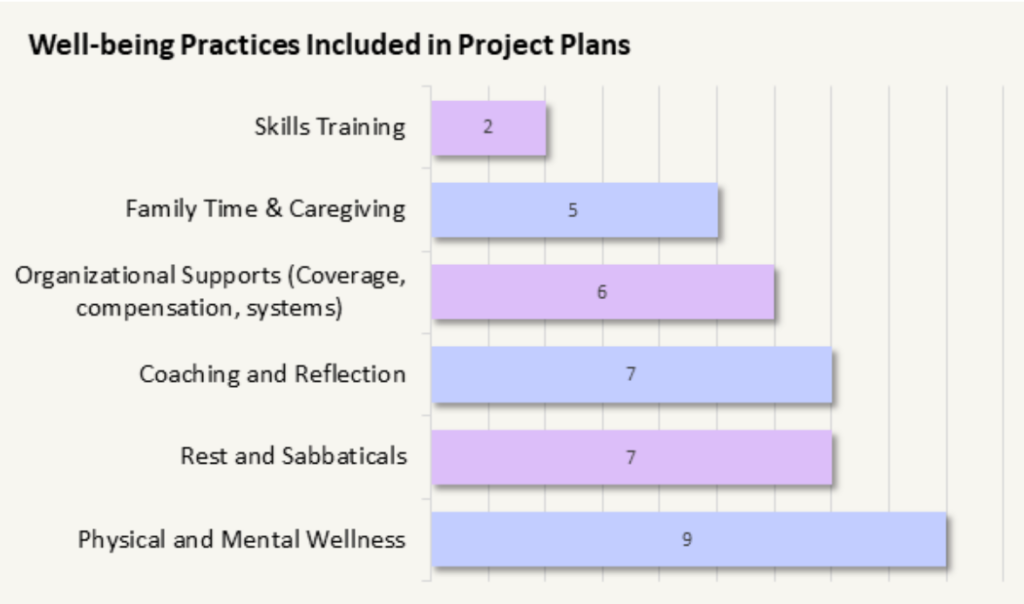
The graph above shows the practices in the first ten Leader Well-being plans, many of which combined several approaches.
-
Well-being is bigger than wellness.
Wellness is one contributor to well-being—not its synonym. While many leaders included activities to support their physical and emotional health, their plans revealed a broader understanding of what sustains effective leadership, including rest, coaching, compensation, family responsibilities, and organizational systems. Well-being is not simply something that individuals practice; it is also something organizations make possible.
-
Dedicated funding can change what leaders believe is possible.
The value of a Leader Well-being grant extends beyond the dollars themselves. Explicitly funding well-being communicates that caring for oneself is legitimate, mission-related, and worthy of investment. This matters in a sector where leaders often feel compelled to put organizational needs ahead of their own. As one applicant reflected: “Seeing initiatives like this remind us that things are changing and that we are worthy of investment and care as we hold the success of our organizations in the same breath.”
-
Leaders need the agency to define what well-being requires.
There is no single formula for leader well-being. Our grantees’ plans included coaching, sabbaticals, executive education, physical wellness, family time, and organizational supports. Rather than prescribing how leaders should pursue well-being, we provided dedicated resources and the flexibility to design plans reflecting their circumstances and responsibilities. The diversity of their choices is not a problem to solve; it reflects a principle at the heart of our grantmaking: the people closest to the work are best positioned to understand what they need.
-
Leader well-being and organizational effectiveness are deeply interconnected.
Leaders consistently described their well-being as connected to their organizations’ effectiveness. They identified relationships between investing in themselves and better decision-making, healthier workplace cultures, stronger leadership pipelines, and greater organizational resilience. Together, these observations point to a hypothesis worth exploring: supporting the people who lead nonprofit organizations may be one of the ways philanthropy helps those organizations become more effective, resilient, and sustainable.
What We Don’t Know Yet
We want to be careful not to overstate the evidence. What we have observed so far comes from leaders’ applications and early experience. What we are still trying to understand is the larger question: whether, how, and under what conditions investments in well-being contribute to leadership capacity, organizational resilience, and, ultimately, community impact.
To help answer it, Fund staff are holding structured learning conversations with each leader at the close of their grant period. Two questions guide them: What practices provide robust support for leaders? And how does focusing on leaders’ well-being strengthen organizational resilience and leaders’ capacity to do their work well?
Together with what we learn from the next round of LW-B grantees, these conversations will help us refine our approach, and we intend to keep sharing what we learn. This piece is an early chapter, not the final word.
Beyond Leaders: The Nonprofit Workforce
Our grantmaking strategy is focused on leader well-being, and we want to be precise about what we have funded and learned. But this work is raising a larger question for us: If the well-being of nonprofit leaders matters to organizational effectiveness and community impact, what about the people throughout nonprofit organizations whose labor makes that impact possible?
It is telling that when leaders in our 2022–2023 pilot had flexible dollars, many directed them to their staff. We are also seeing early signs that leaders who invest in their own well-being are thinking more expansively about the well-being of their teams. Some have engaged their boards in establishing organization-wide policies and practices, including sabbaticals, debt relief, and expanded paid time off, that make well-being a more enduring part of organizational life. These early observations suggest that investing in leader well-being can create a ripple effect, moving beyond individual care toward institutional commitments that support everyone who makes the work possible. Leader well-being may be our entry point into a much larger conversation about what it would mean for philanthropy to treat nonprofit worker well-being as an indispensable condition for community impact.
Where Funders Can Begin
Philanthropy has considerable influence over the conditions in which nonprofit organizations operate. Our decisions about what to fund, how much to provide, and what expectations accompany our grants shape more than organizational budgets. They shape what nonprofit leaders and workers believe they have permission and resources to prioritize. Supporting their well-being is not peripheral to our mission. It is one way we fulfill it.
We are not suggesting that other funders replicate our $50,000 grant. We don’t yet know that our particular model is the model. Instead, we encourage funders to begin somewhere:
- Ask grantee partners what makes their leadership and workforce sustainable.
- Examine your own funding practices and whether they contribute to unhealthy working conditions.
- Fund well-being explicitly.
- Expect reluctance and plan for it.
- Give leaders room to define what they need.
- Learn alongside grantees and share what you discover.
We look forward to trading insights with other funders exploring similar questions.
If we believe nonprofit organizations and the people who work in them are essential community infrastructure, where is that belief visible in how we deploy our philanthropic resources?
Image Credit: Ninthgrid on Unsplash